
APR vs Interest Rate: What's the Difference?
Two Numbers on Every Loan Offer, Often Confused
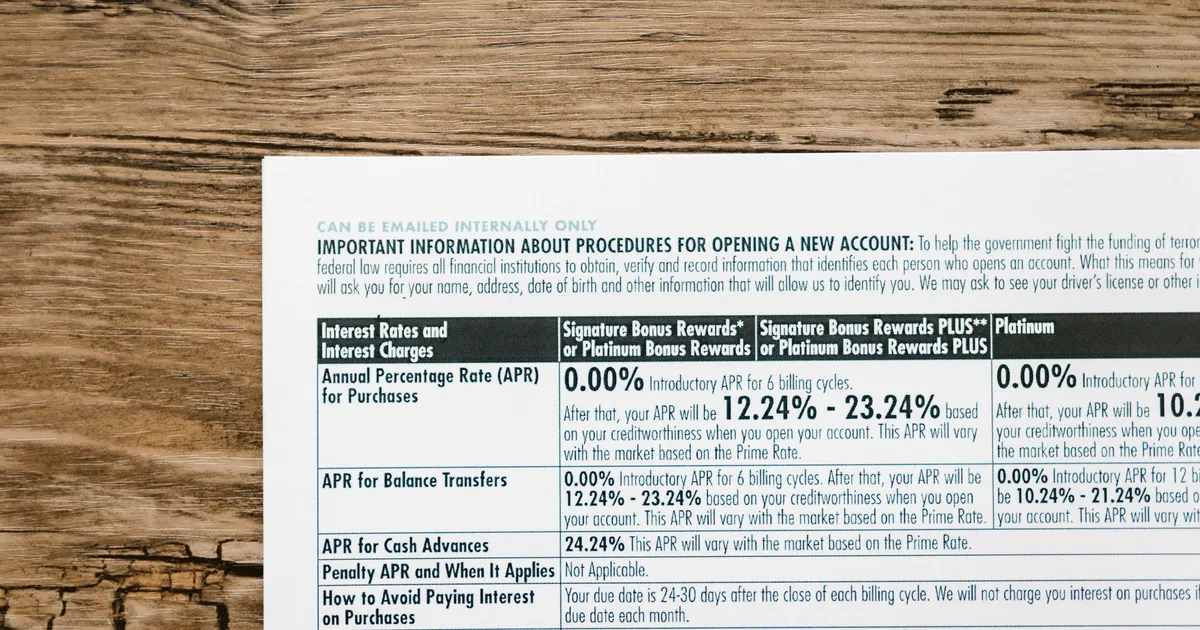
The interest rate is the cost of borrowing the principal itself -- the raw percentage applied to your loan balance to determine interest charges. APR (Annual Percentage Rate) includes the interest rate plus most lender fees, rolled into a single annualized percentage -- which is why APR is almost always the higher of the two numbers, and why relying on the interest rate alone when comparing offers can leave a real cost difference invisible until much later in the process.
Why This Distinction Matters
Comparing two loans by interest rate alone can be misleading if one has significantly higher fees baked in elsewhere -- a loan advertising a slightly lower interest rate but charging substantial origination fees or points could genuinely cost more overall than a loan with a marginally higher rate and minimal fees. APR is designed specifically to let you compare the true total cost of different loan offers on an apples-to-apples basis, folding those upfront costs into one number that reflects the loan's real effective cost over its term, rather than requiring you to separately track and compare fee schedules across offers by hand.
Calculating APR

Use the APR Calculator to see the effective APR once fees are factored in alongside the stated interest rate -- enter the loan amount, stated rate, term, and any known fees, and it computes the single comparable APR figure that reflects the loan's actual total cost.
When the Two Numbers Are Closer Together
A loan with minimal fees will have an APR close to its interest rate; a loan with substantial origination fees, points, or other charges will show a meaningfully higher APR -- and that gap itself is useful information about how fee-heavy an offer is, independent of the headline rate. A large gap between the two numbers on a given offer is worth specifically asking the lender about, since it usually points to fees that weren't obvious from the advertised rate alone.
Why This Matters More for Some Loan Types Than Others

The interest-rate-versus-APR gap tends to matter most for mortgages, where origination fees, points, and closing costs can be substantial relative to the loan, and least for something like a simple, no-fee personal loan where the two numbers are naturally close together. Understanding which category a specific loan falls into helps calibrate how much scrutiny the fee side of an offer actually deserves -- a mortgage comparison genuinely needs the APR view; a straightforward, fee-free personal loan comparison may not differ meaningfully whether you look at rate or APR.
A Practical Way to Compare Multiple Offers
When comparing several loan offers side by side, a simple table with both the interest rate and the APR for each one, alongside the specific fees behind any gap between them, makes the comparison far clearer than trying to keep several offers straight from memory or scattered paperwork. Lenders are generally required to disclose APR clearly as part of their offer, so the information needed for this comparison is usually already available -- it just takes a deliberate step to actually line the offers up together rather than evaluating each one in isolation.
Reading the Fine Print Behind a Low Advertised Rate
An unusually low advertised interest rate relative to competing offers is worth a second look rather than an automatic yes -- sometimes it reflects a genuinely more competitive lender, but sometimes it reflects points paid upfront to buy down the rate, an adjustable rate that will reset higher after an initial period, or other structural details that only show up once you look past the headline number. The APR, combined with actually reading the loan's specific terms, is what surfaces these details before they become a surprise partway through the loan.
Frequently Asked Questions
Should I always choose the loan with the lower APR?
Generally APR is the better comparison metric, but also consider the loan term and whether you plan to pay it off early -- some fee structures matter less if you won't hold the loan for its full term, since certain upfront fees get "spread" across the APR calculation assuming you keep the loan for its entire stated term.
Does a lower APR always mean a lower monthly payment?
Not necessarily -- APR reflects total cost including fees, but your actual monthly payment is calculated from the stated interest rate, loan amount, and term. Two loans can have similar monthly payments with meaningfully different APRs if their fee structures differ, which is exactly why checking both numbers, not just one, gives the complete picture.
Do all fees get included in the APR calculation?
Most standard lender fees are included, but the exact list of what counts can vary somewhat by loan type and jurisdiction -- some third-party costs (like a home appraisal fee on a mortgage) may not be included in every case. Reading a lender's specific APR disclosure, rather than assuming it captures literally every possible cost, is the safer approach.
Is APR the same thing as the interest rate used to calculate my monthly payment?
No -- your actual monthly payment is calculated using the stated interest rate, not the APR. The APR exists as a separate, standardized comparison figure specifically so you can compare total cost across different offers, but it isn't itself plugged directly into the payment formula.
Why would a lender advertise a low interest rate but a much higher APR?
This typically signals a loan with significant upfront fees or points relative to the loan amount -- the interest rate alone doesn't capture those costs, which is exactly the gap APR is designed to reveal. A large gap between the two advertised numbers is worth specifically asking the lender to itemize.
Does refinancing reset the APR comparison?
Yes -- a refinance is effectively a new loan with its own rate, fees, and resulting APR, so it's worth running the same rate-versus-APR comparison on a refinance offer just as carefully as on an original loan, rather than assuming a lower headline rate automatically means a better deal once new closing costs are factored in.
Comments (0)
No comments yet. Be the first to share your thoughts.